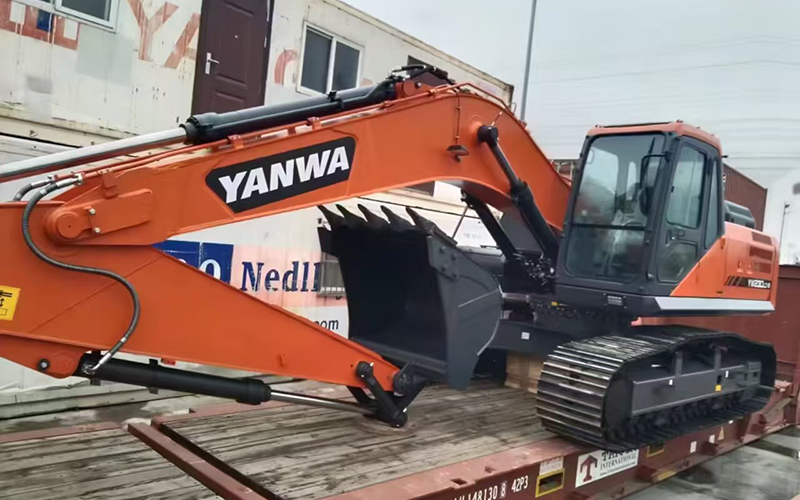
An excavator is a versatile piece of heavy equipment used for digging,lifting,and material handling.Its operation revolves around two primary systems:the undercarriage for movement and the house(or upper structure)for excavation tasks.Mastering the basic controls is essential for safe and efficient operation.
I.Machine Movement(Travel)
The excavator moves on either tracks(crawlers)or wheels.The controls for travel are typically levers or pedals located at the operator's feet(for tracked excavators)or a steering wheel(for wheeled models).
•Tracked Excavators:The operator uses two travel levers.Pushing both levers forward moves the machine straight ahead.Pulling them back moves it in reverse.To turn,the operator moves one lever forward and the other back,causing the machine to pivot."Counter-rotating"or"spin turning"is achieved by moving the levers in opposite directions with equal force,making the machine turn on the spot.
•Wheeled Excavators:These function more like a vehicle,using a steering wheel for direction and pedals for acceleration and braking.An outrigger or stabilizer lever is used to lower hydraulic stabilizer legs to lock the machine in place before beginning digging work.
II.The Main Excavation Movements
The upper structure,or house,can rotate 360 degrees independently of the undercarriage.The primary digging functions are controlled by two hand-operated levers(or joysticks)that manipulate the boom,stick(or arm),and bucket.
Here is the standard pattern for a two-lever control system(ISO pattern is most common):
Left Joystick:
•Forward:Extends the stick(or"arm")outward.
•Back:Retracts the stick inward.
•Left:Swings the house(upper structure)counter-clockwise.
•Right:Swings the house clockwise.
Right Joystick:
•Forward:Lowers the boom.
•Back:Raises the boom.
•Left:Curls the bucket inward(to dig or hold material).
•Right:Dumps or uncurls the bucket.
The Key Movements:
1.Swinging:The rotation of the house on the undercarriage.This is used to move material from the dig point to the dump point.
2.Boom Operation:Raising and lowering the main boom,which provides vertical movement and reach.
3.Stick(Arm)Operation:Extending and retracting the stick,which provides the primary digging force and horizontal reach.
4.Bucket Operation:Curling(digging)and dumping.The bucket can also be used for fine grading or back-dragging.
III.Coordinated Movements for Common Tasks
•Digging a Trench:Lower the boom while curling the bucket to fill it.Use the stick to pull material toward the machine.
•Loading a Truck:Dig material,then simultaneously raise the boom,retract the stick,and swing to position the load over the truck.Finally,uncurl the bucket to dump.
•Fine Grading:Use the edge of the bucket in a flat position,making small adjustments with the boom,stick,and bucket curl to level the ground.
IV.Essential Safety&Operational Notes
•Stability:Always ensure the machine is on stable,level ground.Use stabilizers(if equipped)before digging.
•Smooth Operation:Avoid jerky lever movements.Smooth,simultaneous inputs are the mark of a skilled operator and reduce machine stress.
•360°Awareness:Constantly check your surroundings,especially when swinging the house.Be aware of overhead hazards,underground utilities,and people on the ground.
•Machine Walk-Around:Always perform a pre-operation inspection of the machine,checking for leaks,track/tire damage,and fluid levels.
Mastering these basic controls and understanding how the movements integrate is the first step toward becoming a proficient excavator operator.Always refer to the specific operator's manual for the exact control pattern and safety procedures of your particular machine,as designs can vary.

 +8613356922335